
2026 Expansion Draft Simulation
Several months of time, 70 picks projected. Oh brother.

Introduction
The product of several months of work, I am proud to present the first complete mock expansion draft since 2020. I got the inspiration from a Bill Simmons podcast of a mock NBA expansion draft about a year ago, and it’s been a slow process since. With rumors swirling about 2 new expansion teams being announced in the next few years, it seems like as good a time as any. The rules are as follows, adapted from the 1997 expansion draft for the Diamondbacks and Rays:
Each team picks 35 players (70 players total). The first 28 picks are in “Round 1”, the next 28 are in “Round 2,” and the last 14 are in “Round 3”.
A team can either have the first pick in Round 1, or the first pick in Rounds 2 and 3 and back-to-back picks in the first round at #2 and #3. Otherwise, the teams alternate picks.
Each team can protect 15 players for Round 1, and 3 additional players can be protected before each subsequent round. In total, there will be 21 players protected for each team.
Only one player can be picked from a given organization by each team in a round. Since there are two teams drafting, two players from each organization can be selected per round.
All players with any sort of no-trade protection must be protected. I couldn’t find any resource saying the specifics from past drafts, so I decided to count any type of no-trade clause, so even a 6-team no-trade list qualifies.
Free agents after the 2025 season do not need to be protected (it is assumed that the draft takes place at the beginning of the 2025 offseason, after options and arbitration decisions, but before trades or free agent signings). Therefore, a player like Gleyber Torres does not need to be protected by the Tigers, despite never being a “true” free agent after accepting the qualifying offer.
Any player without MLB service time who entered an organization after turning 19 with at least 3 years of service in the minors must be protected. If they entered an organization before turning 18, the requirement is at least four years of service. I believe this is the same as the Rule 5 draft eligibility rules.
You can find the sheet with the protected players from each organization here. Bolded players have no-trade clauses. When initially protecting players, I operated on what I thought the organization would do (which is beyond my pay grade, but a necessary task to make this possible). When doing the picks for the expansion teams and protections in the following two rounds, I operated based on what I would do; it’s far easier to write the article that way, and second-order thinking and beyond from an organization’s standpoint is just too much.
The philosophy I believe expansion teams would adopt is a focus on young, cost-controlled talent and prospects, especially with pitchers. Teams have been far more protective of their prospects in recent years, in line with their increased odds of success with modern player development, so a chance to snatch a couple of players from each organization on the younger end for free is worth its weight in gold. There’s also some strategy with the knowledge that the other team in the draft can only pick one player from an organization per round. If the other side picks a player from an organization early, you can sit on your preferred player from that organization until later and get a player from a different organization instead. If a player appears to go “too low” in a given round, that’s probably why. While the expansion team could make trades with organizations to guarantee certain players would not be chosen, or sign free agents to lock in certain roster spots ahead of time, I haven’t considered that in this simulation.
Of course, this is all extremely subjective, and it’s a lot of names to work through. There definitely can be mistakes on eligibility, or missing a player that should be protected or selected. I think it does its job, though, of demonstrating what an expansion team under the rules used in past expansion drafts would look like.
1.1 Nashville - Didier Fuentes - 20 - Atlanta Braves - SP
If you’ve read my article about my simulated tenure of the Rangers, you’ll already know I’m a big fan of Fuentes. He’s surged through the minors at just 20 years old with a nearly major-league-ready arsenal, and yet has clear areas to grow in the years ahead. His availability is a testament to the Braves’ swath of players that are justifiable for protection, rather than any serious flaw in his game. Perhaps the most obvious player to expose in Fuentes’ place is Sean Murphy, but I think his above-average bat and glove on a good contract is something a contending Braves team desperately needs. For what it’s worth, if Murphy is available in this spot, I think he gets picked as well.
1.2 Portland - Tobias Myers - 27 - Milwaukee Brewers - SP
Like the Mets, I believe Myers is roughly the same pitcher he was a year ago when he had a 16% K-BB%. The main problem was a high carry fastball that was too often knocked around, but his slider and changeup remain quality. I think it’s fairly reasonable to expect an ERA around 4 next season, which is virtually impossible to find in the player pool, combined with an invaluable 5 years of control.
1.3 Portland - Alex Freeland - 24 - Los Angeles Dodgers - SS
The Dodgers have such an incredible amount of exposed talent that a player considered a top 100 prospect a year ago is available. Freeland is a jack-of-all-trades type: he plays second, short, and third well, hits for decent power, is well-disciplined, and has significantly improved his ability to put bat on ball. He can easily slot into the top of the order for Portland up the middle.
1.4 Nashville - Jose Caballero - 29 - New York Yankees - SS
Caballero is one of the most undervalued players in the league. He’s paced for 3 fWAR per 650 PA in each of the past three years, and in 2025, it was nearly 4. He’s a set-and-forget shortstop, with elite baserunning, and quality of contact that nets him average offensive results. His one wart is his performance against breaking stuff: he’s never been even passable against it, but the whiffs are better than you may think, coming at a rate of just over 30%. With the flexibility to also man shortstop, third base, and a corner outfield spot, Caballero is well deserving of a top selection.
1.5 Portland - Austin Martin - 26 - Minnesota Twins - OF
I lovingly call Austin Martin a “baby” Geraldo Perdomo. He has similarly great contact and chase rates to Perdomo pre-breakout, and has flashed the ability to hit balls at optimal launch angles, a catalyst to Perdomo’s elite play this past season. A key difference is defense: Perdomo is a great defender, while Martin has no true home. If Martin can become passable at the defensive end, he can make himself into a quality regular starter.
1.6 Nashville - Dominic Canzone - 28 - Seattle Mariners - OF
Canzone’s strict platoon role with the Mariners, with various offensive improvements, catapulted him to career-best results, cutting his whiff against 4-seamers by 10% and breakers by 6% en route to a 141 wRC+. He demonstrated a renewed ability to pull the ball, which will let him tap into his power more. Like Martin, his defense in the outfield is questionable, but ultimately tolerable with the thump he provides.
1.7 Portland - Shane Drohan - 27 - Boston Red Sox - SP
Drohan is far too good to stick in Triple-A. He had three pitches post whiff rates over 40%, including his Grade-A changeup that lends favorable comparisons to other lefties who ride quality changeups to success like Joey Cantillo and Ian Seymour. Drohan has a more complete arsenal than either, for my money, and he can push his offerings 2 ticks further. There’s a case to be made that he should go significantly higher based on his talent (#2 ahead of Myers?), because this is a solid starter at worst out of the box.
1.8 Nashville - Joshua Baez - 22 - St. Louis Cardinals - OF
I would imagine that this is the most controversial pick of the first round, but I think Baez has turned a corner as a prospect. After being promoted to Double-A, he managed a .886 OPS at just barely over 22 with quality discipline. Specifically, he elevated his power, doubling his per 162 game pace during his tougher assignment. He’s only available as a result of a lack of pitching talent in the Cardinals’ system, requiring the few they have to be prioritized in their 15 protected slots.
1.9 Portland - Connor Norby - 25 - Miami Marlins- 3B
This is definitely the pick most based on the “two players per team” rule. The second-best option is Adam Mazur or Griffin Conine, and while I’m a fan of the former, he’s largely uninspiring, and the latter is power with a massive hole in his swing. Neither of them ends up getting selected in this round. Norby is a starting caliber 3B with good swing decisions and pulled flyball rates, but lacks the contact or power to really distinguish himself.
1.10 Nashville - Hunter Feduccia - 28 - Tampa Bay Rays - C
The first catcher selected, Feduccia is appealing for his high floor. He won’t overwhelm offensively, with an approach focused on taking pitches and squaring up the ball, nor behind the plate, where he is well below average. But he’s clearly good enough to be a backup at the major league level, and there are few others who meet that requirement in the exposed player pool. One thing to watch is his consistent struggle to square up offspeed offerings.
1.11 Portland - Stephen Kolek - 28 - Kansas City Royals - SP
Kolek is the platonic ideal of a right-handed MLB pitcher in 2025/2026. Six pitches, none of which really jump off the page (maybe the changeup is plus?), and above-average results. Frankly, I’m not fully convinced - a 16% K rate and 25% CSW across 112 innings is putrid - but he should be able to eat innings at a minimum.
1.12 Nashville - Kai-Wei Teng - 27 - San Francisco Giants - SP
A late-season addition to the Giants’ roster, and a recent addition to the Astros’ in real life, Teng offers quality contact suppression across the arsenal. The sweeper is capable, the curve is hard and gets lateral movement extremely well, and the changeup and sinker manage good dive to elicit tons of grounders. There’s the tiniest glimpse of former teammates Logan Webb and Landen Roupp in his approach.
1.13 Portland - Daniel Schneemann - 29 - Cleveland Guardians - 2B
Middle infielders can be hard to find, so while an uninspiring option, Daniel Schneemann offers quality defense up the middle with passable offensive output. He cut down his whiff quite a bit this season, so one can hope that he continues on that path.
1.14 Nashville - Kevin Alcantara - 23 - Chicago Cubs - OF
There are things to like with Alcantara, but the strikeout rate immediately jumps off the page. It’s nearly 30% in Triple-A, which implies a strikeout rate close to 35 at the major league level, a mark hard to justify. His 90th percentile EV jumped 3 mph in his second season at the level, which is a good sign for the power ahead, and his glove has never been a question. But a more offensively minded Jose Siri may be the most likely scenario, and that’s not particularly appetizing.
1.15 Portland - Blaze Alexander - 26 - Arizona Diamondbacks - 3B
Beyond his name, Alexander is desirable for his top-end power potential. He is able to barrel up the ball consistently, but lacks the fly ball rates, or the contact skills (32% K% in ~300 2025 MLB PA), to make full use of it. He doesn’t have too serious a weakness against secondary stuff, although he will likely never be super proficient at punishing it, and he isn’t anything special at the hot corner. I think one hopes for league-average offense with slightly above-average defense at third.
1.16 Nashville - Yohendrick Pinango - 23 - Toronto Blue Jays - OF
There were a number of options here - the main one being Detroit’s former outfielder Justyn-Henry Malloy -, but I favor Pinango for his top-of-the-line power metrics with great contact rates. He’s heavily reliant on seeing fastball variations to make an impact, with no xWOBA above .310 against any secondary pitch type in his time at Triple-A, and his defense is questionable. Pinango should be a solid MLB left-handed option, but he will need to recognize spin better to be a real difference maker.
1.17 Portland - Cole Winn - 26 - Texas Rangers - RP
Many have discussed Jake Latz as a candidate to convert to a starting role, but I think his teammate Cole Winn may have an even better case. His fastball comes in flat and hard, the slider gets great depth, the splitter gets great run, and the sinker and cutter are good contributors. The five-pitch mix is already there: it’s just a question of his velocity over a 5-6 inning stretch, and command, which is already lackluster as a reliever. Even if he lost 3 mph, I think he’d be good enough to be selected here.
1.18 Nashville- Kyle Leahy - 28 - St. Louis Cardinals - RP
Another starter conversion candidate. He’s a good supinator with great extension, but much like Latz, his velocity may sink too low to be a viable starter. While his 4-seam sits a solid 95 now, he struggles to find whiffs on any of his 6 pitches (only his curve is above average), with zone rates that are far too high. Leahy feels like a decent #5 starter that may level up if he can find the edges of the zone more consistently.
1.19 Portland - Gunnar Hoglund - 26 - Sacramento Athletics - SP
“The Athletics” have few options, so I opt for Hoglund, a viable starting arm. He offers good vert with his over-the-top slot, a solid four pitch mix, and above average command. I would be curious how re-introducing a small sweeping slider, or a curve, would alter his fortunes with the 17-inch gap between his fastball and sweeper at present.
*All remaining players in this round are from teams that have already been selected from, so the pick order listed is arbitrary*
1.20 Nashville - Jacob Latz - 29 - Texas Rangers - RP
Latz’s starting candidacy rests on his changeup with great carry from the left-hand side, a blueprint that many pitchers, like the previously drafted Shane Drohan, have used to moderate success. I’m not sold, however, that his 4-seam fastball could survive the velocity loss 5-inning outings would incur, and his curveball and sliders are only passable. I would expect an ERA around 4 without significant improvement in one of his other three pitches if all goes well, which isn’t a ringing endorsement.
1.21 Portland - Blake Tidwell - 24 - San Francisco Giants - SP
A part of the Tyler Rogers trade, Blake Tidwell levelled up his command considerably this season, especially on the sinker and slider. It’s been almost exclusively fastball and slider variations for Tidwell, which may limit his ability to handle left-handed hitting, but at least he’s shown solid results from his changeup in Triple-A (37% whiff rate on 9% usage).
1.22 Nashville - David Festa - 25 - Minnesota Twins - SP
David Festa struggled in 2025, but he has characteristics that make him a strong candidate to target. He has great extension on good velocity, and gets great separation between 4-seam and changeup with just a 6 mph differential. The slider looks plus as well, offering 2 pitches for whiffs. He will always get tons of flyballs with his natural carry, but if he can avoid barrels, he should be a solid pitcher for the years ahead.
1.23 Portland - Miguel Amaya - 26 - Chicago Cubs - C
Amaya is another catcher that ideally serves as a backup, but he’s proved offensively capable across three different campaigns at the bare minimum. He’s struggled to pick up anything that isn’t straight at pace, but he should still manage an 85-90 wRC+ for several years more. Defensively, he’s nothing special, but he may grade out slightly above average long-term.
1.24 Nashville - Garrett Whitlock - 29 - Boston Red Sox - RP
The Red Sox proactively handed Whitlock a 6-year deal with 2 team options, of which only 1 guaranteed year remains. That’s a ton of flexibility for a pitcher that has shown great results as a reliever and flashes as a starter. Fascinatingly, he can get tons of ride from his sinker, but also get preposterous depth on his slider, sweeper, and change, which is amazing separation. Even if he never starts again, I can confidently say he will be a top-end reliever for the duration of his deal.
1.25 Portland - JC Escarra - 30 - New York Yankees - C
Escarra is nothing exciting as a catcher. He’s a solid defensive catcher, a below-average hitter, and is already 30 years old. His one main skill is his discipline - he never chases - and can make great contact in-zone when he does swing. I think he has the ability to maintain a spot on a major league roster for the next few years as a left-handed-hitting catcher, which can’t be found too often.
1.26 Nashville - River Ryan - 27 - Los Angeles Dodgers - SP
One could argue that Ben Casparius should be here instead, but the similarities with Sheehan a year ago for Ryan are too clear to ignore. There’s the obvious fact that they both are just off Tommy John surgery, but they also offer the same plan of attack. A perfectly separated fastball and slider lead the way, with the former as flat as you like at 96, and the latter with above-average depth at a hard 90 mph. The commonalities continue with his solid changeup at 90 mph, but that’s where it ends. Ryan also carries two other offerings: a big sweeping curve at 83 that dominated in his brief Triple-A stint in 2024, and a sturdy sinker. Most importantly, though, River’s command is much shakier than Emmet’s. This is especially relevant with his 4-seamer; he infrequently is able to land it at the top of the zone, and that’s a critical pillar of Sheehan’s success. I think there’s a clear path to viability for Ryan, but I believe it’ll take more than simply getting back to his 2024 form.
1.27 Portland - Grant Holmes - 29 - Atlanta Braves - SP
He may be out for most of 2026, but I think Holmes’ arsenal still makes picking him worth it. His slider is elite with great depth, the curveball is 83 with a 12/6-type arc, and his cutter has great lift at 92. The 4-seamer is the definition of dead zone, but the three secondaries should keep him as an above-average pitcher for most of his 5 remaining years of control.
1.28 Nashville - Abner Uribe - 25 - Milwaukee Brewers - RP
A great, young sinker/slider reliever. He loves the backdoor sinker to RHB, which is an atypical wrinkle for his archetype that he utilizes well.
Now the teams get to protect three more players ahead of the next 28-pick round. As we go deeper into the draft, it’s harder to tell how a team would operate. For example, would the Dodgers protect Teoscar Hernandez here over solid depth OF Ryan Ward? I chose to do so, but it’s possible they would be willing to expose him for at least another round to protect other players in the organization. The same goes for Tanner Scott, whom I do opt to expose for a round longer. The extra year is really killer.
Alright, back to it.
2.1 Portland - Yariel Rodriguez - 28 - Toronto Blue Jays - SP
Yariel’s big advantage is finding outlier pitch shapes on both the arm-side and glove-side. His 4-seam and slider both get more cut than one would anticipate, and while the 4-seam leans more towards dead zone than anything else, the slider can be heavily relied on to perform. He also has a splitter and sinker that get more run than average, and the splitter is the pitch to watch across his whole arsenal. It can certainly be plus, with its great velocity (89 mph), elite run (16 inches), and solid location.
2.2 Nashville - Trei Cruz - 27 - Detroit Tigers - SS
Trei Cruz is another super senior at the Triple-A level, but he’s a plug-and-play middle infielder with great discipline. His chase rate is a great 17%, and his power numbers look passable (110.7 mph max EV translates to ~12 HR?) for a major league regular. I could imagine him as an average leadoff hitter next season if called upon.
2.3 Portland - Ben Williamson - 25 - Seattle Mariners - 3B
I think Williamson is a little better than he let on during his inaugural 295 MLB plate appearances. He should be a stable hand in the lineup, with a mature, patient approach that allows him to handle all pitch types in Triple-A. A 58% groundball rate is probably harsh for his talent, and DRS gave him a great evaluation of +8 in his half-season at the hot corner. Of the options coming up, I’m most confident that Williamson will be a solid major leaguer in three years. The Rays seem to agree.
2.4 Nashville - Ryan Ward - 27 - Los Angeles Dodgers - OF
Ward simply played well in a very hitter-friendly Pacific Coast League at the “old” age of 27, but the power/discipline blend remains enticing. He can get to decent power with an above-average whiff rate thanks to a good number of pulled flyballs, although he lacks great swing decisions or the prospect of handling LHP well.
2.5 Portland - Ryan Gusto - 26 - Miami Marlins - SP
Another kitchen sink pitcher who feels a little better than his performance last year would have indicated. Maybe more changeups can make him a #4 SP? Tough to say.
2.6 Nashville - Kyler Fedko - 26 - Minnesota Twins - OF
Like Ward and Cruz, Fedko was a very successful hitter in Triple-A at 25 years of age. Fedko’s best attribute is his patience - his SEAGER ranks in the 90th percentile - and his ability to pull flyballs makes up for fairly mediocre exit velocities. However, he struggles with breaking balls, and his overall 2025 numbers, which are great at a glance, are juiced by 88 games in Double-A, where he was a year older than the average player. He has a good chance of being a solid big leaguer with his power/speed combination (38 SB in 46 attempts), but a lack of promotion despite a Twins team in deep peril makes one wonder about the internal projections of him.
2.7 Portland - Garrett Cleavinger - 31 - Tampa Bay Rays - RP
There are many east/west pitchers these days, but Cleavinger is a cut above the rest. He can push the speed and approach angle of his pitches to great success, including a great 4-seamer as an effective bridge, and he zones the ball very well. With 2 years of control, there’s plenty of value for the expansion team to float in the trade market.
2.8 Nashville - TJ Rumfield - 25 - New York Yankees - 1B
From one former Yankee prospect to another, Rumfield impresses with pulled flyballs and contact rates, a great combination of attributes for the Stadium, but is merely mediocre everywhere else. Exhibit A: his exit velocities, which were only slightly above average in Triple-A at 25. He probably would only put up a .100 ISO in the majors, too low for most teams’ starting first basemen, but he has the advantage of being passable against LHP from the left side.
2.9 Portland - Romy Gonzalez - 29 - Boston Red Sox - UT
Gonzalez may be a one-trick pony, but he is one of the best at it. Gonzalez flourishes against LHP, consistently putting up All-Star level quality of contact against them with 50+% hard-hit rates. 2025 will likely be remembered as the high-water mark of his career - a 12.6% barrel rate and 57.3% hard-hit rate will do that - but he has the flexibility of playing first, second, and third at a competent level to remain relevant for the next several years. On the open market, I imagine he’d command around $10 million per year, which makes him a valuable trade piece during his next three years of team control.
2.10 Nashville - Max Schuemann - 28 - Sacramento Athletics - UT
I was shocked by Schuemann’s quality of results when I saw his process. Aggressive in-zone, patient outside of it, and great contact rates when it’s over the plate. Unfortunately, I don’t think he could have average power with a metal bat, and his pulled flyball rate is totally anemic. On the plus side, he can play all the infield positions well and can even spec into the outfield. There’s a strong case to be made that I underrated him if he can grow into bottom 25% power, instead of bottom 5%. Then he’s probably a decent starter up the middle.
2.11 Portland - Shay Whitcomb - 28 - Houston Astros - 3B/OF
Despite just 76 plate appearances at 27, I think Whitcomb could be a capable hitter at the MLB level. The main issue is his whiff rate; it’s below average even for Triple-A players, despite being the league’s average age and playing in the PCL, a league that all Triple-A pitchers avoid like the plague. He has a great pulled flyball rate with capable power, but lacks the zone contact rate to take full advantage. In 78 MLB PAs, his K rate was a reasonable 23%, which implies he could manage a K rate at a tenable level (i.e., below 30%) over a full year.
2.12 Nashville - Jordan Walker - 23 - St. Louis Cardinals - OF
Some may think that Walker should have gone significantly higher based on his pedigree, but there is very little in his play over the past two years to justify that. He was decent at the major league level in 2023, and in 2024, he was able to knock the ball around at Triple-A. But he’s lost his ability to hit any sort of soft stuff (even in that Triple-A purple patch, it was nearly a 40% whiff rate), he can barely play the outfield, and he’s always been a bit of a free swinger. Perhaps he fills out into a weak-side platoon player, but it looks like a Kelenic-esque career is ahead of him at this point.
2.13 Portland - DL Hall - 27 - Milwaukee Brewers - RP
Hall presents a very wide release from good extension, but he’s never had the command to back his above-average stuff. He looks destined for reliever purgatory with a solid fastball/slider/changeup combination, although the curveball is interesting enough that it may be able to slip through, too.
2.14 Nashville - Trevor McDonald - 24 - San Francisco Giants - RP
McDonald gives me more Roupp vibes with his curveball/sinker duopoly. They are of two completely different minds, however. McDonald throws it extremely hard like a knuckle curve, similarly to Ben Brown, while Roupp is a softer version with tons of sweep. His command can be equally spotty, however, which, with his limited pitch selection, will severely cap how deep he can go into games.
2.15 Portland - Nick Allen - 27 - Atlanta Braves - SS
He’s a Platinum Glove-level defender and a Triple-A level hitter. When Rob Manfred implements the Designated Fielder, Portland will be in a good spot. Until then, he will be a solid backup.
2.16 Nashville - Daniel Lynch - 29 - Kansas City Royals - SP
Lynch isn’t an inspiring option, but he at least has a deep mix. Perhaps he can push his top offering, a gyro-ish slider, a little further in usage? The problem is that he doesn’t locate it particularly well, unfortunately. Otherwise, he has only a middling changeup to take on righties.
2.17 Portland - Tirso Ornelas - 25 - San Diego Padres - OF
A very patient hitter, Tirso Ornelas should look the part of a decent 4th outfielder by Opening Day. He’s platoon neutral as a lefty, a valuable asset, and while no standout defender, seems serviceable in a corner. Offensively, he’d ideally hit at 8 or 9 with his limited power (2.5% barrel rate in > 300 PCL PAs).
2.18 Nashville - Marc Church - 24 - Texas Rangers - RP
Marc’s key offering is a slider that packs more lift and less cut than the typical one, a bizarre choice for someone who gets cut so effortlessly on his 4-seamer. That already gives an opportunity for a third pitch, a “true” slider, although that may be harsh on his changeup. It gets good movement at 91, but it’s new and rarely featured in the few appearances he managed in 2025. His 4-seamer is built for whiffs, with great vert and cut at 96, but its location often drifts too low in the strike zone to take full advantage. Church looks set to be an above-average reliever, but could push towards an elite option with some refinements and a third pitch to widen the arsenal.
2.19 Portland - Michael Massey - 27 - Kansas City Royals - 2B
I am the chairman of the Michael Massey fan club, which makes me hesitant to inform you that he is being picked in the middle of the second round. After a very productive 2024, his free-swinging nature made him unviable towards anything that wasn’t straight, and his minor league stint didn’t inspire much confidence in a bounce back. His fundamental skills of great in-zone contact and pulled flyball rates have remained intact through it all, though, so my hopes will as well.
*All remaining players in this round are from teams that have already been selected from, so the pick order listed is arbitrary*
2.20 Nashville - Brandon Birdsell - 25 - Chicago Cubs - SP
The 4-seamer may be 2 mph softer than Cade Horton’s, but in all other respects, it’s virtually identical to the fellow Cub pitching project’s interpretation. With the velocity difference in mind, we can comfortably say Birdsell’s would be below league average (Horton’s is dead average). The cutter and curve both look interesting, with the latter being remarkably similar to Horton’s version as well (Horton’s has slightly more depth), but I’m not sure they push him much further than an SP5, assuming an 8% walk rate or so. The changeup is just a mediocre arsenal filler.
2.21 Portland - Oswaldo Cabrera - 26 - New York Yankees - UT
Cabrera has shown flashes of being an average, or even above average, hitter, but by the end of the year, he always finds himself below the going rate. He’s a handy utility man, but that’s about the extent of it.
2.22 Nashville - Anthony Seigler - 26 - Milwaukee Brewers - C
The Brewers found something in Seigler. After being discarded by the Yankees for only managing passable numbers at Double-A at 25, Milwaukee found some extra power in his bat with no disciplinary concessions. He may only be passable behind the dish and max out as a 90 wRC+ bat, but that’s a nice asset.
2.23 Portland - Ricardo Olivar - 24 - Minnesota Twins - C/OF
Olivar didn’t impress as much as Twins brass probably would have liked at Double-A in 2025, but the upside is still clear. He’s well-disciplined with the ability to tap into plus power at the dish, and there’s still the chance that he can play semi-regularly behind it. He may develop into an outfielder that can spec as catcher à la Ben Rice - good as a backup or in an emergency, but not capable of receiving major league pitchers consistently.
2.24 Nashville - Javier Sanoja - 23 - Miami Marlins - 2B
Sanoja only turned 23 in September, and he already is a fringy infielder. His batted ball data will always be too soft to be a real offensive force, but I can see a world where he consistently sneaks 10 home runs per year with the overall production of an average big leaguer.
2.25 Portland - Wenceel Perez - 26 - Detroit Tigers - OF
Perez is the rare switch hitter that prefers to bat from the right side, but he’s still capable against RHP. He’s demonstrated improvement in contact quality, from average to comfortably above, and he can man a corner outfield spot very well. He would have certainly gone earlier in the second round if middle infielders weren’t so badly in need, necessitating Trei Cruz’s selection as the first from the Tigers.
2.26 Nashville - Leo Rivas - 28 - Seattle Mariners - 2B
The second baseman offers patience, and not much else. His Triple-A chase rate, according to ProspectSavant, was a preposterous 14% in 300 plate appearances, and in just over 100 MLB plate appearances, it was an even crazier 8%. There’s not much bite when he does choose to swing the willow, unfortunately. His EVs were horrendous, given the PCL pitching landscape and that he’s above the league’s average age at 28, but a pulled flyball rate well above average should let him sneak a few under (over?) MLB pitchers’ noses. He’s also reliant on 4-seamers and sinkers, which were the only offerings he could be an above-average contributor against in Triple-A. One can hope that he will end up as a below-average #9, but he may not even reach that.
2.27 Portland - Justin Wrobleski - 25 - Los Angeles Dodgers - SP
I don’t understand Wrobelski at all. Five of his pitches elicit groundballs 60% over the time or more, and yet he’s simply been a good reliever and average starter, at best. He performs well in the bulk reliever role with his three fastball variations, but I imagine that they won’t take him as far in a true starting job. I imagine there’s some level of deception going on that I won’t understand.
2.28 Nashville - Bowden Francis - 29 - Toronto Blue Jays - SP
During 2024, when everyone couldn’t get enough of Bowden Francis, I was skeptical. It felt too good to be true - I didn’t see anything that merited top 20 starter performance, specifically with a fastball that looked completely “mid” yet got great results. Now, his stock couldn’t be lower. He’s fresh off a year that produced an ERA over 6.00 and ERA predicting metrics even higher, yet I see some opportunity. The splitter remains interesting, and the curveball should be better than a .454 xWOBA conceded. Definitely worth a gamble.
Now we get to the final round, which is half the length of the prior two. A lot of teams have no enticing options available at this point (if a team had 2 players picked in each of the past two rounds, they’d have 25 players unavailable), so the teams that are picked from are surprisingly different from the prior rounds.
3.1 Portland - Brandon Lockridge - 28 - Milwaukee Brewers - OF
Much like the other former Yankee prospect on the Brewers that was mentioned (Seigler), Lockridge has found new disciplinary skills after going abroad. His chase and whiff rates jumped from below average to well above, and while he’s 28, his bat is at a level where it just might be able to support his great abilities in center field and on the bases. A team picking him would hope that his walk rate (5.4%) will jump a little closer to his 13% minor league mark to be a real baserunning threat that can justify a good amount of time batting at 9. Otherwise, he’s probably a pinch runner and defensive replacement in the best of times.
3.2 Nashville - Lazaro Estrada - 26 - Toronto Blue Jays - RP
A debut at 26, Estrada possesses a very interesting mix that makes me wonder if he, too, could be pushed to a starting role. He naturally gets great carry on all of his pitches, and his FB/slider tunnel is already quite effective. His curve is an in-zone strike stealer, and his splitter is a Roki Sasaki-inspired shape with just 4 inches of run at 84. Even if he lost 2 mph as an SP, he probably would be serviceable. As a reliever, he should be top-end.
3.3 Portland - Nick Yorke - 23 - Pittsburgh Pirates - 2B/OF
He’s a “buy low” pick after losing many of the improvements that defined his great 2024 in 2025. His average EV fell 4 mph between seasons, despite being a year older at the same Triple-A level, and his solid discipline deteriorated with it. He’s defensively dubious at second base, and while a capable baserunner, is nothing outstanding. I think he could be a capable platoon player at second base or a corner outfield spot, but he would have to reverse his recent trends across the board.
3.4 Nashville - Otto Kemp - 26 - Philadelphia Phillies - 1B
Kemp is a curious case as a right-handed first baseman with thump that also packs top-end speed (95th percentile by Savant in 62 games). He’s the quintessential platoon first baseman otherwise; his .977 OPS vs LHP at Triple-A would incentivize a part-time role on quite a few MLB rosters. The combination of being a weak-side platoon player and a first baseman, however, unfortunately makes him the least valuable asset one could have on an MLB position player depth chart. Romy Gonzalez, picked in the previous round, at least plays other infield spots somewhat competently and with a much better track record offensively.
3.5 Portland - Pedro Pages - 27 - St. Louis Cardinals - C
A passable backup catcher, but not much else. Ideally, a reserve sequestered in Triple-A. At least he has above-average bat speed?
3.6 Nashville - AJ Blubaugh - 25 - Houston Astros - SP
He’s largely here out of respect for strong public-facing analyst James Schiano, who might be a bigger fan of Blubaugh than his parents. I can see why one might like him: he pronates effortlessly, and gets the ball in the right sort of areas. His repertoire at present is far too narrow, though - a 4-seamer, sweeper, and changeup with mediocre (4-seamer, sweeper) to slightly above average (changeup) shapes isn’t going to cut it. I could see the upside if he expands his horizons, though - the curveball may lean plus as a looping strike stealer, and his rarely-used cutter might push that mark as well if the readings on low usage are accurate.
3.7 Portland - Travis Adams - 26 - Minnesota Twins - SP
Adams doesn’t impress in any particular area, but he’s not really deficient anywhere either. Perhaps his 91 mph cutter with great lateral movement can propel him to above-average results. Probably just a Triple-A depth arm, though.
3.8 Nashville - Yanquiel Fernandez - 23 - Colorado Rockies - OF
It’s hard to make sense of Fernandez, who, after popping strong top-end EVs on low K rates in Triple-A, managed only 4 home runs in 150 plate appearances of platoon work despite lots of opportunities to hit at Coors Field. Part of that is age (he just turned 23), but I think his Triple-A performance was the best we’ll ever get of Yanquiel. He chased 40% of the time in the PCL and 36% of the time in the majors, and continues to lack any notable defensive or baserunning qualities.
3.9 Portland - Justin Slaten - 28 - Boston Red Sox - RP
I considered Ronan Kopp from the Dodgers here, but I rated Slaten’s chances of starting far higher than Kopp’s chances of becoming a dominant left-handed reliever. Slaten naturally gets lots of cut: his 4-seam runs just 2 inches, while his cutter cuts 5, and he can push upper 90s on the radar gun. His curve gets much less cut than one would expect, then, and is more of a whiff pitch than its 12-6ish shape would suggest. Turning that into a strike stealer with a high in-zone rate could make that starting vision a reality, but otherwise, he’s a capable back-end guy.
3.10 Nashville - Mitch Spence - 27 - Sacramento Athletics - SP
Spence offers a nice cutter/sweeper combo that is prone to getting knocked around, along with a passable sweeping curve. He gets cut so naturally that his 10% usage sinker gets just 8 inches of run with great depth, and while it’s gotten hammered, I think it can have slightly better days ahead. He could also mess with a kick change to try to obtain a reliable option that moves away from LHB.
3.11 Portland - Colton Gordon - 27 - Houston Astros - SP
Gordon is an uninspiring 27-year-old rookie with a deep mix and a pronating bent. He’s a good fill-in starter, and would probably pass muster as a reliever with a narrowed mix (i.e., 4-seam, sweeper, curve?). Specifically, his lack of whiffs on any pitch is troubling. His changeup is best, but only clocks in at 26%.
3.12 Nashville - Nathan Church - 25 - St Louis Cardinals - OF
A toolsy outfielder, Church could be a solid platoon outfielder for the next few years. He didn’t overwhelm in his Triple-A stint, posting just a 4% barrel rate at near the level’s average age, and doesn’t elevate the ball well enough to compensate. But his defense may push plus, which makes him a potentially effective asset off the bench. Think Cedric Mullins without pulled flyballs, or the elite defense. That doesn’t sound too promising, now that I think about it.
3.13 Portland - Griff McGarry - 26 - Philadelphia Phillies - SP
Griff McGarry is probably too good for Triple-A at this point, but despite his selection in the Rule 5 draft by the Nationals, it’s not clear he can consistently get MLB hitters out. His 4-seam/sweeper combination doesn’t appear too overwhelming, and it will inevitably play down with his erratic location. Perhaps he’s a capable reliever? Portland will bank on that.
3.14 Nashville - Yohan Ramirez - 30 - Pittsburgh Pirates - RP
Despite being an MLB journeyman, there are real attributes to look forward to here. He has great extension, can get his fastball variants flat at the top of the zone, and his curveball is very effective at 83. Maybe he can’t start, but he’s a solid RP option with 3 years left.
Conclusion
Now, the assembled lineups. First, my rough starting lineups vs. RHP and LHP for Nashville:
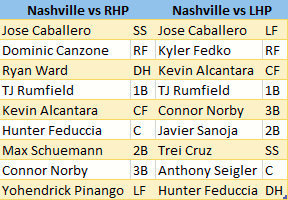
Nashville clearly lacks quality options vs. LHP; Feduccia is tasked with weak-side platoon work at DH, and despite Rumfield’s prowess against same-side pitching, he shouldn’t be forced to stay at 4. The lineup vs RHP is passable, although Pinango likely should be omitted for a quality free agent option. Next, Portland:
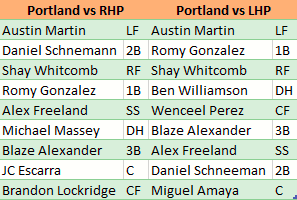
Portland is the opposite tale: quality vs LHP, including Alex Freeland all the way down at 7. Against RHP, it’s more uneven. Massey should probably not be on the roster at all, and Daniel Schneeman is in a prime hitting spot against all odds. Whitcomb’s low GIDP tendencies (with his high strikeout and flyball rates) land him at 3. Now, the pitchers:
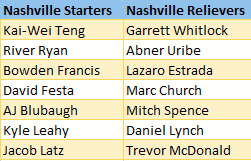
The order for this is very arbitrary, and one would have to choose which 5 of the starter group to commit to the rotation. I leaned away from people who would have to be converted, hence why Leahy and Latz are #6 and 7.The relief corps is strong, especially if you include those two in teh fold.
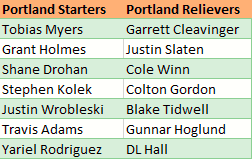
Portland’s starters are better in my opinion, but at the cost of a weaker bullpen. I still don’t understand Wrobleski, (Pitching+ loves him!) and Grant Holmes is coming off surgery. Winn is a clear starting pitching project if one is desirable to the front office.
In all, the Brewers, Twins, and Cardinals had the most selections with 5. Along with those three, the Red Sox, Athletics, and Blue Jays had at least one player selected in every round. Several teams had 0, with by far the most notable being the Mets. My odds-on favorite for the most picks, the Dodgers, only had 4. I considered a lot of their older, depth pitchers in the last round, but they either were too thin in command or repertoire to make it worth the selection.
That’s it! Top 50-related stuff up next. Exciting times.
Sources
ProspectSavant
RobertOrr’s Dashboard
BaseballReference
FanGraphs
BaseballSavant
Wikipedia (for past draft rules)
Spotrac/Cot’s for No-Trade Clauses
This is awesome. That Nashville team would be super fun to watch.
If you had to guess how many wins these teams would earn in their debut seasons, what would you estimate?
Kudos for the effort put into this.